
Structural Concrete Repair in Portobello
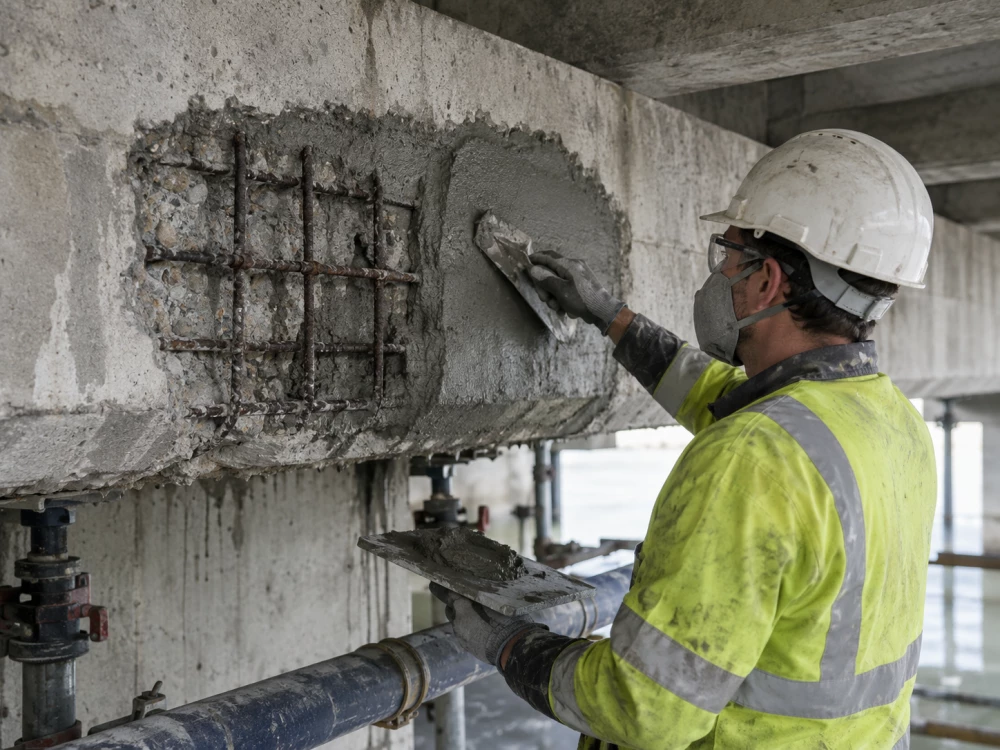
Get in touchStructural concrete can deteriorate while continuing to form an important part of a building or structure.
A beam may lose sections of concrete cover. Reinforcement within a column can become exposed. A structural slab can develop cracking or spalling. Impact can remove concrete from a load-bearing element.
These defects require more than restoring the appearance of the surface.
We provide structural concrete repair in Portobello for reinforced concrete beams, columns, slabs, walls and other structural elements.
Get a Structural Concrete Repair Quote
Which Concrete Element Is Damaged?
The function of the damaged concrete influences how the repair is approached.
A local defect in a ground-bearing floor is different from deterioration within a column supporting the structure above it.
Structural repairs can involve:
Concrete Columns
Columns transfer loads through a structure.
Spalling, impact damage and reinforcement corrosion can remove sections of concrete and expose the steel within the column.
The extent of deterioration needs to be established before the damaged section is reinstated.
Concrete Beams
Beams can develop cracking, spalling and reinforcement-related deterioration along their sides and soffits.
Where concrete cover has separated, the reinforcement beneath it can become visible.
Structural Slabs
Suspended and other structural slabs can require repairs to cracking, spalled areas, damaged edges and reinforcement-related deterioration.
Concrete Walls
Structural concrete walls can develop local or widespread defects depending on their exposure, construction and use.
The repair needs to reflect both the deterioration and the function of the element.
What Has Happened Inside the Concrete?
The missing material visible at the surface may only be the final stage of deterioration occurring within reinforced concrete.
One important mechanism involves reinforcement corrosion.
As steel corrodes, the resulting corrosion products occupy more volume than the original steel.
Pressure develops within the surrounding concrete.
The sequence can become:
steel reinforcement
corrosion develops
expansion around reinforcement
concrete cracks
cover delaminates
concrete spalls
reinforcement becomes exposed
A structural repair needs to consider the mechanism underneath the visible defect rather than simply replacing the piece of concrete that has fallen away.
Request a Structural Concrete Assessment
Structural Concrete Repair After Spalling
Spalling can expose reinforcing bars and reduce the original concrete section.
The first question is how far the deterioration extends.
Loose or delaminated concrete may continue beyond the obvious damaged area.
The repair boundary therefore needs to be established from the actual condition of the concrete.
Where appropriate, unsound material can be removed until a suitable substrate is reached and the reinforcement requiring treatment is sufficiently exposed.
The missing section can then be reinstated using an appropriate structural repair system.
When Reinforcement Is Exposed
Exposing reinforcement changes the repair.
The steel becomes accessible for preparation and assessment.
Corrosion products and other unsuitable material need to be removed so that the reinforcement can interact appropriately with the reinstatement material.
The condition of the bar also needs consideration.
Cleaning the reinforcement may reveal that most of its original section remains.
In other situations, corrosion may have caused more substantial loss.
That distinction can influence what happens next.
Loss of Reinforcement Section
Replacing the missing concrete does not replace steel that has corroded away.
Where significant reinforcement section has been lost, the amount of remaining steel needs to be considered against the requirements of the structural element.
Additional reinforcement may be required as part of the designed repair.
That creates a different repair sequence:
Concrete deterioration identified → reinforcement exposed → steel condition assessed → reinforcement requirement established → concrete reinstated
The repair should not jump directly from the first stage to the last.
Breaking Out Concrete From a Structural Member
Removing concrete from a structural element temporarily changes that element.
This is particularly important where substantial sections need to be broken out around reinforcement.
Before removal begins, consideration needs to be given to the effect that the reduced section will have while the repair is open.
Some repairs can require loads to be reduced or transferred using temporary support.
The required approach depends on the element, repair extent and structural circumstances.
Discuss a Structural Concrete Repair
Temporary Propping During Concrete Repair
Propping can be required where the repair involves removing concrete that contributes to the loaded structural section.
Temporary support allows load to be managed while damaged material is removed and the structural section is reinstated.
This is not a requirement for every patch of concrete.
It becomes relevant where the extent and structural significance of the repair justify it.
The need for temporary works should therefore be determined before substantial structural breakout rather than after concrete has already been removed.
Structural Concrete Column Repair Portobello
Column repairs can involve relatively small local defects or deterioration extending around a substantial part of the member.
Common conditions include:
Spalled concrete
Exposed reinforcement
Corrosion-related cracking
Impact damage
Broken corners
Failed previous repairs
The geometry of a column can mean that reinforcement becomes exposed on more than one face as deteriorated concrete is removed.
Where this occurs, the extent of breakout and effect on the remaining column need to be considered as part of the repair.
Impact-Damaged Concrete Columns
Columns within car parks, warehouses and industrial buildings can be vulnerable to vehicle and machinery impact.
A collision can produce an obvious local defect, but the visible damage should not be assumed to represent the complete effect of the impact.
Cracking can extend beyond the missing concrete.
Reinforcement may also have been exposed or affected.
Where the column is load-bearing, significant impact damage should be assessed before the damaged profile is simply reconstructed.
Structural Concrete Beam Repair
Beam repairs can involve the sides, ends and soffit of the member.
Where reinforcement corrosion is involved, cracking can develop along the position of the reinforcing steel before sections of concrete cover break away.
Repair can involve:
Identify deterioration → remove unsound concrete → expose affected reinforcement → prepare steel and substrate → reinstate section
Where the repair is expected to restore structural performance, the requirements for the completed member need to be established as part of the repair design.
Concrete Soffit Repairs Portobello
The underside of a slab or beam introduces a different working condition.
Loose or delaminated concrete can potentially detach from an overhead surface.
Access and protection of the area below can therefore become part of the project before the permanent repair begins.
Once the repair area is made safe, deteriorated material can be removed and the reinforcement and substrate prepared.
Suitable repair materials can then be applied to reinstate the soffit.
Structural Slab Repairs
Structural slabs can develop several forms of deterioration at once.
A project may involve cracking in one area, local spalling elsewhere and reinforcement exposure at another location.
Rather than treating each defect as unrelated, the wider condition of the slab can be considered.
This is particularly relevant where similar deterioration appears repeatedly across the same structure.
Multiple defects can indicate that the repair strategy needs to extend beyond isolated patching.
Structural Crack Repair
A crack in structural concrete should not automatically be filled because it is visible.
The cause matters.
A stable crack can present a different repair condition from one associated with ongoing movement.
Cracking can also provide evidence of other deterioration, including reinforcement corrosion.
Where the crack has potential structural significance, assessment should establish what is happening before an injection or filling method is selected.
Structural Concrete Injection
Injection can form part of certain structural concrete repairs.
Suitable materials can be introduced into cracks, voids or other defects where the repair specification requires it.
One possible objective is force transmission across a suitable crack.
Other injection systems can be intended for different purposes.
The required performance therefore needs to be established first.
Repair objective → injection type → material selection
rather than:
Visible crack → inject resin
Fire-Damaged Structural Concrete Portobello
Fire can affect concrete and reinforcement differently depending on the severity and duration of exposure.
The visible surface does not necessarily reveal the complete depth of damage.
Before repair, the condition and residual properties of the affected concrete and reinforcement may need to be established.
This information determines how much material needs to be removed and whether additional reinforcement or other structural intervention is required.
The damaged section can then be repaired according to the findings.
Structural Concrete Repairs in Car Parks
Concrete car parks contain a mixture of structural elements exposed to different conditions.
A single structure can include:
Columns
Beams
Decks
Ramps
Soffits
Parapets
Stair structures
A column might suffer vehicle impact while a soffit elsewhere shows reinforcement-related spalling.
These are different deterioration mechanisms within the same structure.
The repair programme should distinguish between them rather than applying a single treatment throughout the car park.
Structural Repairs in Warehouses and Factories
Industrial buildings can present both engineering and operational constraints.
Structural concrete repairs may need to take place around:
Forklift routes
Machinery
Production equipment
Racking
Loading operations
Working areas
Access to the damaged member is only part of the problem.
The effect of repair work on surrounding operations also needs to be considered.
Where appropriate, work can be phased around individual areas while maintaining safe separation from ongoing operations.
Repairing Previous Structural Concrete Repairs
A failed repair can provide evidence about the condition underneath it.
The failure might occur within the repair material, along the interface with the original concrete or immediately outside the repaired area.
Each pattern suggests a different question.
Repair has debonded:
Was the substrate suitable?
New spalling has appeared beside the patch:
Is deterioration continuing in the surrounding reinforced concrete?
Repair has cracked:
Is movement still occurring?
Reinforcement corrosion has returned:
Was the underlying corrosion mechanism adequately addressed?
Removing a failed repair can expose information that was hidden while the patch remained in place.
Request a Structural Repair Assessment
Repairing a Structure Is Not the Same as Strengthening It
Structural repair and structural strengthening should remain separate concepts.
A structural repair addresses damage or deterioration.
Strengthening increases or modifies structural capacity.
Consider two beams:
Beam A was designed for its current loading but has developed local reinforcement corrosion and spalling.
It may require structural repair.
Beam B remains in good condition but must carry significantly greater loads following a building alteration.
It may require strengthening.
There can also be projects where deterioration has reduced capacity and both repair and strengthening become necessary.
When Strengthening Becomes Part of the Project
Strengthening should follow structural assessment and design.
It can become relevant where a member is unable to provide the capacity required for its proposed use.
Depending on the structure and design, strengthening techniques can include:
Additional reinforced concrete section
Externally bonded reinforcement
Fibre-reinforced polymer systems
Steel plate bonding
Other engineered strengthening solutions
These should not be presented as interchangeable products.
The strengthening system follows the structural requirement.
Structural Bonding
Structural bonding can form part of certain strengthening and repair designs.
It can be used to connect strengthening materials to existing concrete or to create a structural connection between concrete elements.
Because the bond forms part of the load-transfer mechanism, preparation and specification are important.
This differs from simply bonding a cosmetic patch to the surface.
Structural Repair Materials
The properties required from a structural repair material depend on where and how it will be used.
Selection can consider:
Existing concrete
What substrate is being repaired?
Repair geometry
Is the repair shallow, deep, vertical or overhead?
Structural requirement
What role must the reinstated section perform?
Exposure
What conditions will the repaired member face?
Application
How will the material be placed and compacted?
Structural and non-structural repair materials are treated separately within BS EN 1504, reinforcing the point that material selection should follow the repair requirement.
A Structural Repair Has to Rebuild More Than the Shape
A visually complete repair is not necessarily a structurally appropriate repair.
The objective is not simply:
hole → mortar → smooth surface
For deteriorated reinforced concrete, the logic is closer to:
structural element
↓
deterioration identified
↓
structural significance assessed
↓
unsound concrete removed
↓
reinforcement condition established
↓
repair requirements determined
↓
structural section reinstated
↓
completed member returned to its required function
This is why structural concrete repair needs to begin with the element and its condition rather than a predetermined repair product.
Structural Concrete Repair Contractors Portobello
We provide structural concrete repair in Portobello for commercial, industrial and other reinforced concrete structures.
Work can include repairs to beams, columns, slabs, walls and soffits affected by cracking, spalling, reinforcement corrosion, impact damage and other forms of deterioration.
Where the condition could affect structural performance, the appropriate assessment and repair requirements should be established before work proceeds.
Send photographs showing the damaged concrete and the complete structural element where possible, together with information about the building, location of the damage and any known history.
This provides a useful starting point for determining the likely scope of the repair.
We cover Portobello (Edinburgh)