
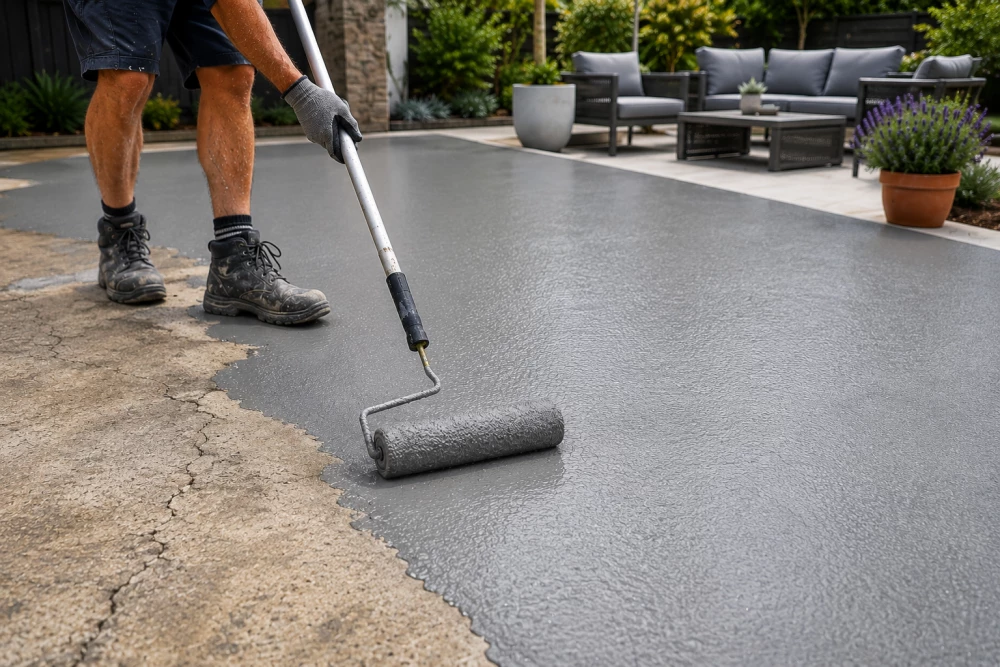
Concrete Resurfacing in Garforth
Get in touchA concrete slab can remain fundamentally serviceable while its working surface becomes worn, rough or extensively damaged.
In these situations, the problem may no longer be best treated as a collection of individual patches.
Concrete resurfacing allows the existing floor to be prepared, repaired where necessary and provided with a new working surface.
We provide concrete resurfacing in Garforth for warehouses, factories and other commercial and industrial concrete floors.
Get a Concrete Resurfacing Quote
Look at the Surface Before Choosing the System
“Worn concrete” can describe several different conditions.
The surface might be dusty and weak.
It could contain shallow delamination.
Years of traffic may have worn away the original finish.
Previous coatings may be peeling.
Alternatively, the floor may contain dozens of local repairs that have left the surface increasingly inconsistent.
These conditions do not automatically require the same treatment.
Before resurfacing, we need to establish what part of the existing surface is suitable to remain.
Dusting Concrete Floors
Dusting produces a weak, powdery surface.
Traffic and even routine sweeping can continue to loosen material from the upper layer of the concrete.
Installing a new bonded system directly onto this weak material can leave the resurfacing dependent on a substrate that is already deteriorating.
The weak layer therefore needs to be identified during preparation.
Depending on its severity and the intended use of the floor, treatment may range from an appropriate surface treatment to removal of the affected layer and installation of a suitable bonded resurfacing system.
Concrete Floor Delamination Garforth
Delamination occurs where a layer near the surface becomes detached from the main body of the slab.
Some delaminated areas can appear relatively normal until they are investigated.
Others eventually break away and create obvious surface defects.
Resurfacing should not simply bridge over loose or detached concrete.
The extent of unsound material needs to be established so that the new system is installed onto a suitable substrate.
Request a Concrete Resurfacing Assessment
Heavily Worn Concrete
Industrial traffic can gradually remove material from a floor.
Forklift routes, turning areas and other high-use sections may show considerably more deterioration than the surrounding slab.
The important distinction is whether wear remains localised or has become a broader surface problem.
Where wear extends across substantial sections, resurfacing can provide a more coherent approach than introducing an increasing number of individual repair patches.
Removing the Weak Surface
A resurfacing system is only as reliable as the material beneath it.
Preparation may therefore involve removing weak, contaminated or otherwise unsuitable surface material.
Mechanical preparation can expose stronger concrete and create a surface appropriate for the proposed system.
The exact method depends on:
Existing floor condition
Previous finishes
Contamination
Required removal depth
Proposed resurfacing material
Site constraints
Preparation should follow the condition found on site rather than assuming every floor requires identical treatment.
What Happens to Potholes and Deeper Defects?
Resurfacing should not be used as a convenient way to hide deeper damage.
A pothole extending substantially below the surrounding surface may need local repair before the wider resurfacing layer is installed.
The same applies to larger spalled areas and failed patches.
This creates a staged approach:
deeper defect → local repair
wider surface deterioration → resurfacing
Combining the two allows different depths of deterioration to be dealt with appropriately.
Existing Cracks Need Their Own Decision
Cracks can continue through or affect materials installed above them.
Before resurfacing, existing cracking should therefore be reviewed rather than simply covered.
A stable crack may require one approach.
A moving crack can require another.
A crack with significant edge deterioration may first need local reconstruction.
Where cracking could indicate a more significant problem with the slab, that issue should be investigated before resurfacing proceeds.
Do Not Lose the Floor Joints
Joints remain part of the existing slab when a floor is resurfaced.
Where a joint is intended to accommodate movement, covering it with a continuous rigid layer does not eliminate the movement beneath.
The resurfacing detail should account for the joint and its intended function.
Damaged joint arrises may also require repair before the wider floor surface is treated.
This is particularly relevant in warehouses where joints repeatedly intersect forklift routes.
Removing Old Floor Coatings
Existing coatings can become part of the substrate problem.
A coating may be:
Well bonded
Partially worn
Peeling
Contaminated
Previously recoated
Incompatible with the proposed system
The condition needs to be established before another layer is installed.
Where an existing finish is unsuitable to remain, preparation can remove it and expose the concrete underneath.
The resurfacing system can then be designed around the substrate that will actually support it.
Oil-Contaminated Concrete Garforth
Workshops and factories can contain concrete exposed to oils and process fluids.
Contamination can penetrate beyond what is visible at the surface.
This matters for bonded resurfacing systems because the new material depends on the condition of the substrate.
Preparation therefore needs to consider contamination rather than treating it as a purely cosmetic stain.
Where necessary, the extent of contamination and compatibility with the proposed system should be established before resurfacing.
Warehouse Concrete Resurfacing
Warehouse floors are not used uniformly.
A typical operation creates repeated movement between:
goods-in → storage → picking → packing → dispatch
The highest levels of wear can therefore appear along predictable routes.
Main aisles, turning areas and doorways can deteriorate while sections underneath static storage remain comparatively unaffected.
A resurfacing project can be designed around the actual pattern of deterioration rather than assuming every square metre requires identical work.
Factory Concrete Resurfacing Garforth
Factory floors can have several surface conditions within the same building.
One production area may experience forklift traffic.
Another may be exposed to oils or fluids.
Areas around machinery can contain previous repairs.
Assembly sections may receive much lighter traffic.
This makes zoning useful.
Instead of treating the factory as one uniform floor, the resurfacing requirements can be considered according to the use and condition of individual areas.
Request an Industrial Resurfacing Quote
Resurfacing Workshop Floors
Workshop floors can accumulate years of localised damage.
Previous patches, worn coatings, oil exposure and vehicle movements can produce a surface made up of several different materials and conditions.
Preparation is particularly important in this environment.
Old repairs that remain sound may potentially form part of the substrate, while loose or failed sections need removing.
The resulting floor can then be treated according to the resurfacing system selected for its future use.
Loading and Dispatch Areas
Loading areas combine concentrated traffic with frequent turning and braking.
Surface wear can therefore become particularly noticeable around doorways and routes between the warehouse and external loading area.
Where deterioration is widespread across the working surface, resurfacing can reinstate the area as a defined zone.
Deeper local defects can be repaired as part of the preparation stage.
Partial Concrete Resurfacing
Resurfacing does not automatically mean treating the entire floor.
A 5,000m² warehouse might contain substantial deterioration within 1,000m² of heavily trafficked routes while the remaining concrete continues to perform adequately.
A defined section can potentially be treated independently.
The boundaries and transitions between resurfaced and retained areas then become part of the specification.
This can keep the scope focused on the sections that actually require intervention.
Full Floor Resurfacing
There are also floors where deterioration is widespread.
Repeated repairs, surface wear and failing finishes may extend throughout most of the working area.
In these situations, a wider resurfacing programme can provide a more consistent approach.
Existing defects still need to be considered individually during preparation.
Full resurfacing does not mean ignoring what is underneath.
It means treating those defects as part of a coordinated refurbishment of the wider surface.
Concrete Wearing Surfaces Garforth
Where the resurfaced layer itself will become the working floor, its intended use needs to be considered.
Industrial wearing surfaces can be exposed to:
Pedestrian traffic
Forklifts
Pallet trucks
Trolleys
Machinery
Impact
Abrasion
The requirements for the completed surface therefore influence the resurfacing specification.
A lightly used commercial area does not necessarily need the same build-up as a busy industrial traffic route.
Bonded Concrete and Cementitious Resurfacing
Cementitious and polymer-modified materials can be used for appropriate concrete reinstatement and resurfacing applications.
Where a new layer is bonded to existing concrete, preparation of that existing surface is particularly important.
The relationship is straightforward:
existing concrete → prepared substrate → bond → resurfacing layer
Failure at the substrate or interface can compromise the new surface regardless of how strong the resurfacing material itself is.
Resin-Based Resurfacing
Resin-based materials can provide another option for appropriate industrial floor refurbishment.
Different resin systems offer different build depths and performance characteristics.
The specification should consider the substrate, traffic, contamination and required finish.
A resin system should not be selected simply because the existing floor looks damaged.
The condition underneath still determines whether local repair, preparation or other treatment is required first.
Surface Regularity and the Finished Floor
Resurfacing can improve a deteriorated working surface, but the required finished profile needs to be understood before work starts.
Some buildings have more demanding requirements than others.
Warehouses using particular material-handling systems can be sensitive to floor profile and regularity.
Where specific tolerances are required, these should form part of the project specification rather than assuming that any resurfacing system automatically produces the same result.
Get a Concrete Resurfacing Quote
Resurfacing Before Resin Flooring or Another Finish
Sometimes resurfacing is not the final flooring system.
Its purpose can instead be to create a suitable substrate for a subsequent finish.
The project might involve:
existing damaged concrete
↓
mechanical preparation
↓
local repairs
↓
resurfacing / levelling
↓
final resin or flooring system
This separates substrate correction from the final floor finish.
The complete build-up should be compatible from the existing slab through to the surface that will ultimately receive traffic.
When Resurfacing Is the Wrong Approach
Resurfacing has limits.
It is primarily a way of addressing surface condition while retaining the existing concrete slab.
It should not automatically be used where the underlying slab has significant structural deterioration or unresolved movement.
Warning signs can include substantial displacement, significant structural cracking or deterioration extending deeply through the concrete.
These conditions can require further assessment before deciding whether resurfacing has any role.
The key distinction is:
surface problem → resurfacing may be appropriate
underlying slab problem → investigate the slab first
Resurfacing or Replacing the Concrete?
Replacement is a substantially different intervention.
It removes and reconstructs the existing floor or affected slab section.
Resurfacing retains the underlying concrete.
The decision therefore depends heavily on whether that existing concrete is suitable to remain.
If deterioration is concentrated at or near the surface, retaining the slab may be possible.
Where the slab itself is no longer suitable for its required use, resurfacing the top does not correct that underlying condition.
Phased Resurfacing in Working Buildings Garforth
A warehouse or factory may need to continue operating while the floor is refurbished.
Where the building layout permits, resurfacing can be divided into working zones.
For example:
Area A closed → preparation and repairs → resurfacing → required cure → area reopened
Operations can then move and another section becomes available.
The available working window can influence both the resurfacing material and project sequence.
Curing and return-to-service requirements depend on the selected system and site conditions, so they should be established for the specific project rather than stated as one fixed period.
What We Need to Assess a Resurfacing Project
Wide photographs are particularly useful.
A close-up can show us a damaged patch, but it cannot show whether that patch represents 1% or 50% of the floor.
For an initial concrete resurfacing enquiry, provide:
Approximate floor area
Wide photographs
Close-ups of deterioration
Building use
Existing coatings or finishes
Forklift or vehicle use
Areas of dusting or wear
Cracks
Damaged joints
Previous repairs
Known contamination
Available shutdown periods
For larger sites, a floor plan showing different surface conditions can help establish the proposed resurfacing zones.
Concrete Resurfacing Contractors Garforth
We provide concrete resurfacing in Garforth for warehouses, factories, workshops and other commercial and industrial premises.
Projects can involve worn concrete, dusting surfaces, failed previous finishes and broader deterioration where individual patch repairs are no longer sufficient.
The resurfacing specification depends on what remains underneath.
Send photographs of the overall floor and its worst affected areas together with the approximate floor size and current use.
We can then consider the likely preparation, repairs and resurfacing requirements.
We cover Garforth (West Yorkshire)