
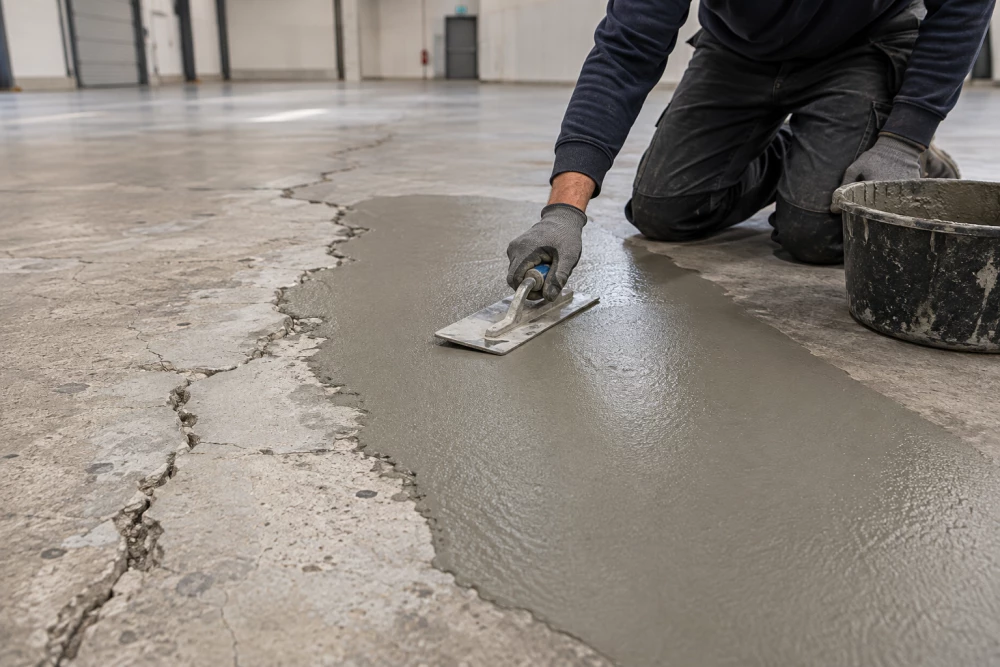
Concrete Floor Repair in Wellington
Get in touchConcrete floors rarely deteriorate evenly.
One section may contain a damaged joint while the surrounding slab remains sound. Another floor may have cracks, potholes and worn areas distributed across several traffic routes.
The repair should reflect the condition of the floor rather than automatically treating the entire surface.
We provide concrete floor repair in Wellington for warehouses, factories, workshops and other commercial and industrial premises.
Get a Concrete Floor Repair Quote
What Condition Is Your Concrete Floor In?
Before choosing a repair material, look at how the damage is distributed.
There is an important difference between:
One isolated defect
A local repair may be sufficient.
Several unrelated defects
Individual repairs can potentially be combined into a planned programme.
Repeated deterioration across the floor
The wider condition of the slab may need investigation.
Widespread surface breakdown
Resurfacing or broader refurbishment may be more appropriate than continually adding patches.
This gives us a starting point for determining how much of the floor actually needs attention.
Potholes in Concrete Floors
A pothole is an area where material has broken away and created a depression within the floor.
In an industrial building, even a relatively small pothole can become noticeable when it lies within a regularly used route.
The repair needs to extend to suitable surrounding concrete.
Loose and fragmented material can be removed before the missing section is reinstated with an appropriate repair material.
The depth and geometry of the repair influence the material and preparation required.
Cracked Concrete Floors Wellington
Cracks need to be considered differently from missing sections of concrete.
Some cracks remain relatively stable.
Others can continue to move because of changes in loading, temperature, moisture or other factors.
The importance of a crack can also change when its edges begin deteriorating.
Once small hard wheels repeatedly cross a damaged crack:
crack → edge impact → fragmented concrete → wider damaged zone
The condition of the crack edges can therefore become an important factor in deciding whether remedial work is required.
Request a Concrete Floor Repair Quote
Damaged Floor Joints
Joints are intentionally incorporated into many concrete floors.
Damage frequently occurs at the concrete immediately alongside them.
These joint edges, or arrises, can gradually deteriorate under repeated vehicle movements.
A joint repair may require the damaged concrete to be reconstructed while retaining the function of the joint itself.
That distinction matters.
Repairing the broken concrete does not necessarily mean eliminating the joint.
Where movement is required, the completed detail should continue to accommodate it.
Spalled Concrete Floors
Spalling describes areas where pieces of concrete have separated from the original surface.
On a ground-bearing industrial floor, this may appear as shallow surface damage or a deeper local defect.
The damaged area needs to be assessed to determine where suitable concrete remains.
Loose material can then be removed and the section reinstated.
If reinforcement is exposed within the repair, the condition of the steel becomes an additional consideration.
Worn Concrete Surfaces
Not all floor deterioration produces obvious holes.
Repeated traffic can gradually wear the upper surface.
A warehouse might develop worn routes along its main aisles while lightly used areas remain relatively unaffected.
Factories can show similar patterns around production and material-handling routes.
The extent of wear determines whether local treatment remains practical or whether a broader floor refurbishment should be considered.
Warehouse Floor Repair Wellington
Warehouse floors are organised around movement.
Materials typically travel through a sequence such as:
goods-in → storage → picking → packing → dispatch
The floor underneath these routes can receive substantially more traffic than areas elsewhere in the building.
Typical repair locations include:
Main forklift aisles
Cross-aisles
Racking aisles
Doorways
Picking areas
Loading areas
Goods-in
Dispatch
When assessing a warehouse floor, it is useful to know not only where the defect is but how often equipment crosses it.
Factory Floor Repairs
Factory floors combine movement with production.
Damage can occur around machinery, workstations, assembly areas and material-handling routes.
This creates a different repair environment from an empty concrete slab.
Fixed equipment can restrict access.
Production can limit when an area is available.
Oils or process contamination can affect preparation.
The repair programme therefore needs to consider the manufacturing environment alongside the concrete itself.
Get an Industrial Floor Repair Quote
Workshop Concrete Floor Repairs
Workshops can develop concentrated damage around working bays and vehicle routes.
The floor may be exposed to:
Vehicle movements
Jacks and equipment
Impact
Oils and fluids
Repeated loading
Previous coatings
Where contamination is present, the condition of the substrate needs particular consideration before installing a bonded repair.
The repair area can then be prepared according to the defect and intended repair system.
Loading Bay Floor Repairs
Loading areas concentrate vehicle and material-handling activity into relatively small sections.
Concrete can deteriorate around approaches, doorways and heavily trafficked loading routes.
A defect positioned directly where a forklift turns or passes through a doorway can experience considerably more use than a similar defect elsewhere.
Repair priorities can therefore be based partly on operational importance rather than simply ranking defects by physical size.
Broken Concrete Around Doorways
Doorways deserve particular attention on industrial floors.
Traffic from a much larger area is funnelled through a narrow opening.
If a joint, crack or existing repair crosses that opening, almost every vehicle entering the area may interact with it.
A small defect can therefore deteriorate rapidly.
The repair can target the damaged section without automatically extending into serviceable concrete elsewhere in the floor.
Edge and Corner Repairs
Concrete can break away from exposed edges as well as from the middle of a slab.
Corners and thresholds can be vulnerable to impact because they have less surrounding concrete supporting the exposed edge.
Repair can involve removing damaged material and rebuilding the missing profile.
The new repair needs to terminate against suitable existing concrete rather than tapering into loose or fragmented material.
Repairing Previous Floor Patches Wellington
An industrial floor can accumulate repairs over many years.
Some remain serviceable.
Others crack, loosen or break away.
Before replacing a failed patch, it is worth considering how it failed.
A repair that separates cleanly from the substrate suggests a different issue from one where the surrounding original concrete has broken down.
Similarly, repeated cracking through the same area can indicate continuing movement.
Removing the failed material provides an opportunity to assess what is underneath before another repair is installed.
Request a Floor Repair Assessment
Isolated Floor Damage
Where most of the floor remains in good condition, local repair keeps the scope focused.
For example, a warehouse might have:
Two damaged joint crossings
One pothole near dispatch
A broken doorway edge
These defects can potentially be treated individually.
There is little reason to reconstruct serviceable concrete simply because damaged areas exist elsewhere within the building.
Multiple Floor Repairs
The approach changes when damage appears repeatedly.
Rather than organising every patch as a separate project, defects can be mapped across the floor.
Each location can then be categorised.
For example:
A — pothole
B — damaged joint
C — cracked floor
D — failed previous patch
E — surface deterioration
This creates a defined repair schedule and helps establish the materials, access and working areas required.
For large warehouses and factories, a marked floor plan can be particularly useful.
When Does a Floor Need Resurfacing Instead?
Local repair is not always the most efficient approach.
If deterioration covers a significant proportion of the floor, continually cutting out and replacing small areas can create an increasingly fragmented surface.
At this point, the question becomes whether the underlying concrete remains suitable for a wider resurfacing system.
A simple way of separating the intent is:
Local defects → concrete floor repair
Widespread surface deterioration → concrete resurfacing
Major slab problems → further investigation / potential replacement
The boundary between these depends on the actual floor condition.
Preparing Concrete Floor Repairs
Preparation is determined by the defect.
Loose material needs to be removed so that the new repair is not bonded to concrete that is already deteriorating.
The repair may also need clearly defined edges and an appropriate surface profile.
Where contamination, old coatings or failed repair materials are present, these can affect the preparation required.
The objective is to reach a substrate suitable for the selected repair system.
Choosing the Repair Material
There is no single material that suits every concrete floor repair.
The specification can be influenced by:
Depth of repair
Size of repair
Existing concrete
Forklift traffic
Impact
Joint movement
Temperature
Contamination
Application conditions
Required return to service
Cementitious, polymer-modified and resin-based materials can each have appropriate applications.
Product selection should follow these requirements rather than using the same material for every defect on the floor.
Floor Repairs Around Live Operations Wellington
Industrial floor repairs often need to take place while the rest of the building continues operating.
This makes access part of the repair strategy.
Instead of closing a complete warehouse, work can sometimes be divided into zones.
Zone isolated
↓
traffic redirected
↓
damaged concrete prepared
↓
repair installed
↓
required cure achieved
↓
route reopened
↓
next repair area begins
Whether this is practical depends on the building layout and repair system.
Return-to-service times should be based on the selected material and site conditions rather than a generic promise applied to every repair.
Get a Concrete Floor Repair Quote
Repairing the Floor Before a New Finish
Concrete repairs are often required before another flooring system is installed.
A new resin coating, screed or other finish should not be expected to compensate for significant defects underneath it.
The sequence may instead be:
inspect substrate → identify defects → complete repairs → prepare floor → install new flooring system
Cracks and joints still require particular consideration because movement within the original slab can affect materials installed above them.
Repairing the substrate first provides a more appropriate basis for subsequent flooring work.
What Should You Send Us?
For a concrete floor repair enquiry in Wellington, start with photographs.
Take close-ups of the damage but also step back and photograph the surrounding floor.
The wider images tell us whether the problem is isolated or part of a larger deterioration pattern.
It also helps to provide:
Approximate floor area
Number of damaged locations
Building use
Forklift or pallet-truck traffic
Existing floor coatings
Previous repairs
Available access
Any known movement
Required operational windows
For multiple defects, a simple floor plan with repair locations marked can make the scope much clearer.
Concrete Floor Repair Contractors Wellington
We provide concrete floor repair in Wellington for warehouses, factories, workshops and other commercial and industrial buildings.
Repairs can include potholes, cracks, damaged joints, spalling, broken edges and failed previous repairs.
The aim is to match the scope to the floor: repairing individual defects where deterioration is localised and considering broader refurbishment where the damage is widespread.
Send us photographs of the floor and the affected areas together with information about how the building is used.
We can then consider the extent of repair required.
We cover Wellington (Somerset)